Leverage the benefits of assessment in human whole blood.

C3a
Measurement of the early phase anaphylatoxin C3a, indicates complement activation.

C5a
Measurement of the late phase anaphylatoxin C5a indicates complement activation.

Bb Split product
Measurement of the anaphylatoxin Bb split product. An indication of complement activation through the alternative pathway.
READOUTS
Why choose our complement assays?
- Use of human whole blood for more predictive results.
- Overcomes the limitations of animal (such as NHPs) and in vitro models.
- A comprehensive analysis covering ADCC, CDC and Complement Activation-Related Pseudoallergy (CARPA).
- Compliance with the latest regulatory updates.
- Expert scientific support throughout the study.
Why assess complement activation in drug development?
The complement system comprises over 50 proteins organized across three interconnected pathways: classical, alternative, and lectin. Each pathway is crucial for immune surveillance and pathogen elimination, bridging innate and adaptive immunity while cross-talking with plasma activation cascades. Because these proteins can trigger a massive immune response, stimulating phagocyte activation, inflammation, and membrane attack complex (MAC) formation, unintended complement activation is an important safety consideration in drug development .
Understanding the mechanisms behind this activation and recognizing the potential for adverse effects is crucial for developing safer therapies.
A key complement-mediated adverse event is Complement Activation-Related Pseudo-Allergy (CARPA), reported across multiple therapeutic modalities. Undetected CARPA risk can affect both patient safety and clinical development, potentially leading to infusion reactions, dose delays, clinical holds, or even program termination. Assessing complement markers such as C3a, C5a, and Bb early in development can therefore help identify and mitigate these risks. ID.Flow® enables simultaneous measurement of these markers in a single experimental run using a human-relevant whole-blood environment. Read our Scientific Blog.
Regulatory shift: complement assessment and human relevant models
The regulatory expectations for complement assessment have shifted in recent years. A 2023 FDA guidance recommends assessment of complement split products, including C3a, C5a, and Bb (1), while guidance for oligonucleotide therapeutics specifically highlights complement activation risks and limitations of non-human primate models (2). Together with increasing FDA and EMA support for human-relevant New Approach Methodologies (NAMs), this reinforces the expectation of early, physiologically relevant complement assessment in developing safer therapeutics. Read more on our Scientific Blog.
Measure Complement Activation in ID.Flow®
Study all complement responses in one assay. The ID.Flow® system is capable of providing detailed information on complement activation, cytokine release, as well as platelet and immune cell activation using fresh human whole blood. This makes it an excellent tool for gaining a comprehensive understanding of the human immune response to a drug.

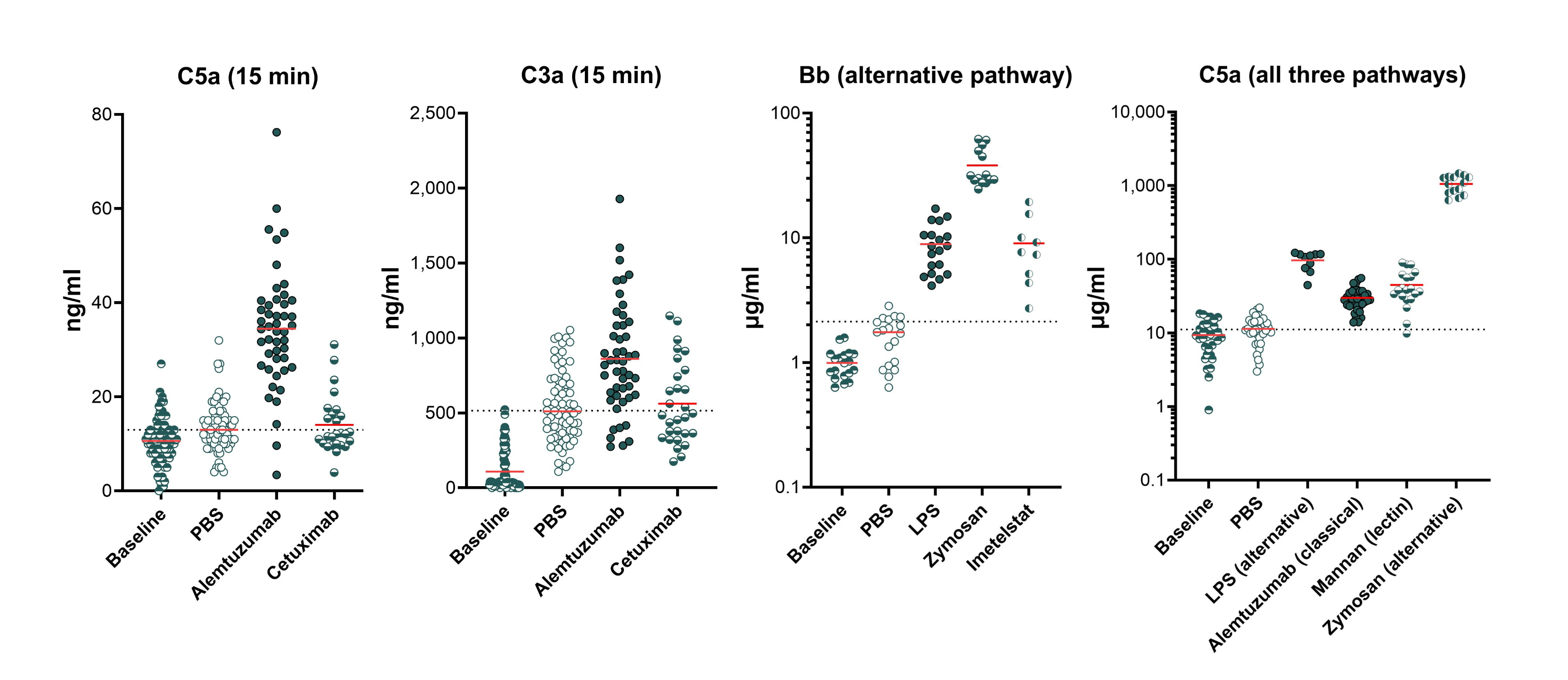
Figure 1. Complement activation induced by IgG1 antibodies with the target present, in human blood. All three complement pathways can be studied in ID.Flow®.


Why choose Us?




MORE SERVICES

Cytokine Release
Sensitive cytokine release prediction in fresh human whole blood.

White Blood Cells, Activation & Depletion
Activation of B cells, T cells, NK cells, monocytes, and granulocytes is simultaneously analyzed in fresh human whole blood.
Platelets, Count & Activation
Platelet activation, conjugates, aggregation, counts, inhibition...
ADCC / CDC
Simultaneous study of ADCC and CDC in fresh human whole blood.